Note
Go to the end to download the full example code.
Fused Graphical Lasso experiment
We investigate the performance of Fused Graphical Lasso on powerlaw networks, compared to estimating the precision matrices independently with SGL. In particular, we demonstrate that FGL - in contrast to SGL - is capable of estimating time-consistent precision matrices.
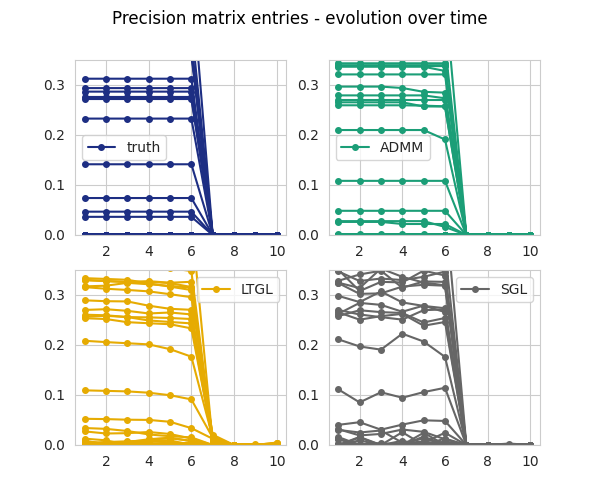
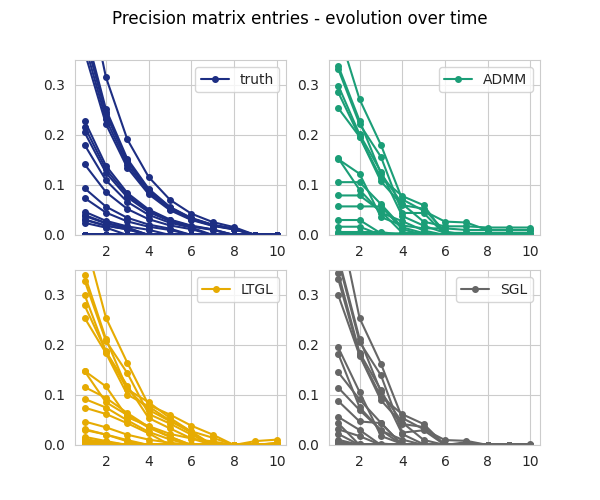
We generate a precision matrix with block-wise powerlaw networks. At time K=5, one of the blocks disappears and another block appears. A third block decays exponentially over time (indexed by K).
# sphinx_gallery_thumbnail_number = 2

import numpy as np
from sklearn.covariance import GraphicalLasso
from regain.covariance import TimeGraphicalLasso

from gglasso.solver.admm_solver import ADMM_MGL
from gglasso.helper.data_generation import time_varying_power_network, sample_covariance_matrix
from gglasso.helper.experiment_helper import discovery_rate, error
from gglasso.helper.utils import get_K_identity
from gglasso.helper.experiment_helper import plot_evolution, plot_deviation, surface_plot, single_heatmap_animation
from gglasso.helper.model_selection import aic, ebic


p = 100
K = 10
N = 5000
M = 5
L = int(p/M)

reg = 'FGL'

Sigma, Theta = time_varying_power_network(p, K, M, scale = False, seed = 2340)

S, sample = sample_covariance_matrix(Sigma, N)


results = {}
results['truth'] = {'Theta' : Theta}
Animate precision matrix over time
colored squares represent non-zero entries
anim = single_heatmap_animation(Theta)
Parameter selection (FGL)
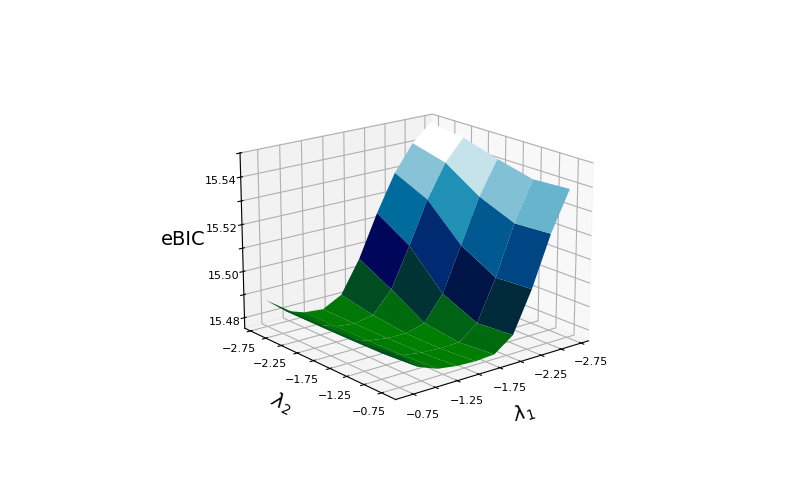
We do a grid search over \(\lambda_1\) and \(\lambda_2\) values. On each grid point we evaluate True/False Discovery Rate (TPR/FPR), True/False Discovery of Differential edges and AIC and eBIC.
Note: the package contains functions for doing this grid search, but here we also want to evaluate True and False positive rates on each grid points.
l2 = 2*np.logspace(start = -1, stop = -3, num = 5, base = 10)
l1 = 2*np.logspace(start = -1, stop = -3, num = 10, base = 10)
L2, L1 = np.meshgrid(l2,l1)
grid1 = L1.shape[0]; grid2 = L2.shape[1]

ERR = np.zeros((grid1, grid2))
FPR = np.zeros((grid1, grid2))
TPR = np.zeros((grid1, grid2))
DFPR = np.zeros((grid1, grid2))
DTPR = np.zeros((grid1, grid2))
AIC = np.zeros((grid1, grid2))
BIC = np.zeros((grid1, grid2))

Omega_0 = get_K_identity(K,p)
Theta_0 = get_K_identity(K,p)
X_0 = np.zeros((K,p,p))

for g2 in np.arange(grid2):
    for g1 in np.arange(grid1):

        lambda1 = L1[g1,g2]
        lambda2 = L2[g1,g2]

        sol, info =  ADMM_MGL(S, lambda1, lambda2, reg , Omega_0, Theta_0 = Theta_0, X_0 = X_0, tol = 1e-8, rtol = 1e-8, verbose = False, measure = False)

        Theta_sol = sol['Theta']
        Omega_sol = sol['Omega']
        X_sol = sol['X']

        # warm start
        Omega_0 = Omega_sol.copy()
        Theta_0 = Theta_sol.copy()
        X_0 = X_sol.copy()

        dr = discovery_rate(Theta_sol, Theta)
        TPR[g1,g2] = dr['TPR']
        FPR[g1,g2] = dr['FPR']
        DTPR[g1,g2] = dr['TPR_DIFF']
        DFPR[g1,g2] = dr['FPR_DIFF']
        ERR[g1,g2] = error(Theta_sol, Theta)
        AIC[g1,g2] = aic(S, Theta_sol, N)
        BIC[g1,g2] = ebic(S, Theta_sol, N, gamma = 0.1)


# get optimal lambda
ix= np.unravel_index(np.nanargmin(BIC), BIC.shape)
ix2= np.unravel_index(np.nanargmin(AIC), AIC.shape)

l1opt = L1[ix]
l2opt = L2[ix]

print("Optimal lambda values: (l1,l2) = ", (l1opt,l2opt))
ADMM terminated after 46 iterations with status: optimal.
ADMM terminated after 43 iterations with status: optimal.
ADMM terminated after 42 iterations with status: optimal.
ADMM terminated after 42 iterations with status: optimal.
ADMM terminated after 42 iterations with status: optimal.
ADMM terminated after 42 iterations with status: optimal.
ADMM terminated after 42 iterations with status: optimal.
ADMM terminated after 42 iterations with status: optimal.
ADMM terminated after 42 iterations with status: optimal.
ADMM terminated after 42 iterations with status: optimal.
ADMM terminated after 46 iterations with status: optimal.
ADMM terminated after 41 iterations with status: optimal.
ADMM terminated after 42 iterations with status: optimal.
ADMM terminated after 42 iterations with status: optimal.
ADMM terminated after 43 iterations with status: optimal.
ADMM terminated after 42 iterations with status: optimal.
ADMM terminated after 42 iterations with status: optimal.
ADMM terminated after 42 iterations with status: optimal.
ADMM terminated after 42 iterations with status: optimal.
ADMM terminated after 42 iterations with status: optimal.
ADMM terminated after 46 iterations with status: optimal.
ADMM terminated after 41 iterations with status: optimal.
ADMM terminated after 42 iterations with status: optimal.
ADMM terminated after 42 iterations with status: optimal.
ADMM terminated after 42 iterations with status: optimal.
ADMM terminated after 41 iterations with status: optimal.
ADMM terminated after 22 iterations with status: optimal.
ADMM terminated after 38 iterations with status: optimal.
ADMM terminated after 19 iterations with status: optimal.
ADMM terminated after 18 iterations with status: optimal.
ADMM terminated after 25 iterations with status: optimal.
ADMM terminated after 41 iterations with status: optimal.
ADMM terminated after 42 iterations with status: optimal.
ADMM terminated after 42 iterations with status: optimal.
ADMM terminated after 38 iterations with status: optimal.
ADMM terminated after 19 iterations with status: optimal.
ADMM terminated after 20 iterations with status: optimal.
ADMM terminated after 17 iterations with status: optimal.
ADMM terminated after 14 iterations with status: optimal.
ADMM terminated after 13 iterations with status: optimal.
ADMM terminated after 46 iterations with status: optimal.
ADMM terminated after 41 iterations with status: optimal.
ADMM terminated after 42 iterations with status: optimal.
ADMM terminated after 41 iterations with status: optimal.
ADMM terminated after 34 iterations with status: optimal.
ADMM terminated after 21 iterations with status: optimal.
ADMM terminated after 16 iterations with status: optimal.
ADMM terminated after 15 iterations with status: optimal.
ADMM terminated after 15 iterations with status: optimal.
ADMM terminated after 15 iterations with status: optimal.
Optimal lambda values: (l1,l2) =  (np.float64(0.02583099330029768), np.float64(0.06324555320336758))
Solving time-varying problems with SGL
We now solve K independent SGL problems and find the best \(\lambda_1\) parameter.
ALPHA = 2*np.logspace(start = -3, stop = -1, num = 10, base = 10)
SGL_BIC = np.zeros(len(ALPHA))
all_res = list()

for j in range(len(ALPHA)):
    res = np.zeros((K,p,p))
    singleGL = GraphicalLasso(alpha = ALPHA[j], tol = 1e-3, max_iter = 20, verbose = False)
    for k in np.arange(K):
        model = singleGL.fit(sample[k,:,:].T)
        res[k,:,:] = model.precision_

    all_res.append(res)
    SGL_BIC[j] = ebic(S, res, N, gamma = 0.1)

ix_SGL = np.argmin(SGL_BIC)
results['SGL'] = {'Theta' : all_res[ix_SGL]}
Solve with ADMM
Omega_0 = get_K_identity(K,p)

sol, info = ADMM_MGL(S, l1opt, l2opt, reg, Omega_0, rho = 1, max_iter = 500, \
                                                        tol = 1e-10, rtol = 1e-10, verbose = False, measure = True)


results['ADMM'] = {'Theta' : sol['Theta']}
ADMM terminated after 99 iterations with status: optimal.
Solve with regain
regain needs data in format (N*K,p).
regain includes the TV penalty also on the diagonal, hence results may be slightly different than ADMM_MGL.
tmp = sample.transpose(1,0,2).reshape(p,-1).T


ltgl = TimeGraphicalLasso(alpha = N*l1opt, beta = N*l2opt  , psi = 'l1', \
                          rho = 1., tol = 1e-10, rtol = 1e-10,  max_iter = 500, verbose = False)
ltgl = ltgl.fit(X = tmp, y = np.repeat(np.arange(K),N))


results['LTGL'] = {'Theta' : ltgl.precision_}
Plotting: deviation, eBIC surface, recovery
Description of plots:
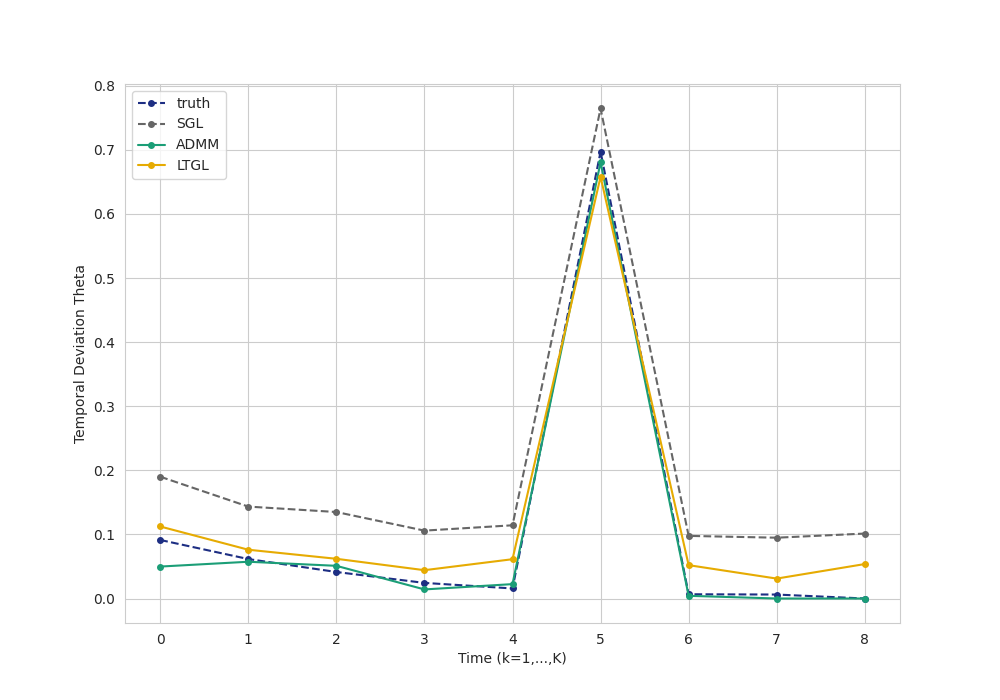
Deviation of subsequent precision matrices: SGL varies heavily over time while FGL is able to recover the true deviation quite well.
Plot each entry of the disappearing block over time (one line = one precision matrix entry)
Plot each entry of the exponentially decaying block over time (one line = one precision matrix entry)
Surface plot of eBIC over the grid of \(\lambda_1\) and \(\lambda_2\).
Theta_admm = results.get('ADMM').get('Theta')
Theta_ltgl = results.get('LTGL').get('Theta')
Theta_sgl = results.get('SGL').get('Theta')


print("Norm(Regain-ADMM)/Norm(ADMM):", np.linalg.norm(Theta_ltgl - Theta_admm)/ np.linalg.norm(Theta_admm))


plot_deviation(results)

plot_evolution(results, block = 0, L = L)

plot_evolution(results, block = 2, L = L)

fig = surface_plot(L1, L2, BIC, name = 'eBIC')
Norm(Regain-ADMM)/Norm(ADMM): 0.033085273769036604
Total running time of the script: (2 minutes 20.164 seconds)